# What 97 developer docs deliver to AI agents
Across 97 products, an agent can almost always read the page. The gap is in the indexes and interfaces that let it do more than read.
- Published: 2026-10-20
- Kind: analysis
- Author: Sean Knight
- Tags: developer docs for AI agents, AI Agent Readiness Test, AI Agent Readiness Score, MCP, llms.txt
An AI agent that serves developers does not arrive already knowing a product. It fetches the documentation when it needs to act, then writes code or calls an interface based on what it reads. That moment, an agent reading the docs and deciding what to do next, is now part of how products get chosen, which makes developer docs for AI agents a measurable property of a product.
The AI Agent Readiness Test audited 97 products on October 16, 2026, and this article analyzes that published audit on docsforagents.com. The test, described in full at [the methodology page](/methodology/), scores out of 100 what an agent receives from a product's public documentation. Every check is a direct HTTP request to the public docs, and the response itself is the evidence, so each result is reproducible. No AI model reads the documentation or judges it, which keeps the numbers independent of how well the prose happens to read.
Scores cover three groups: content delivery worth 50 points, discovery worth 25, and agent capabilities worth 25. Two extra-credit items, llms-full.txt and an embedded docs AI assistant, carry one point each and cannot lift a score above 100. Across the 97 products, one pattern holds throughout: an agent can almost always read the page it reaches, but far less often can it find a machine-readable index or call a documented interface.
## What the scores show
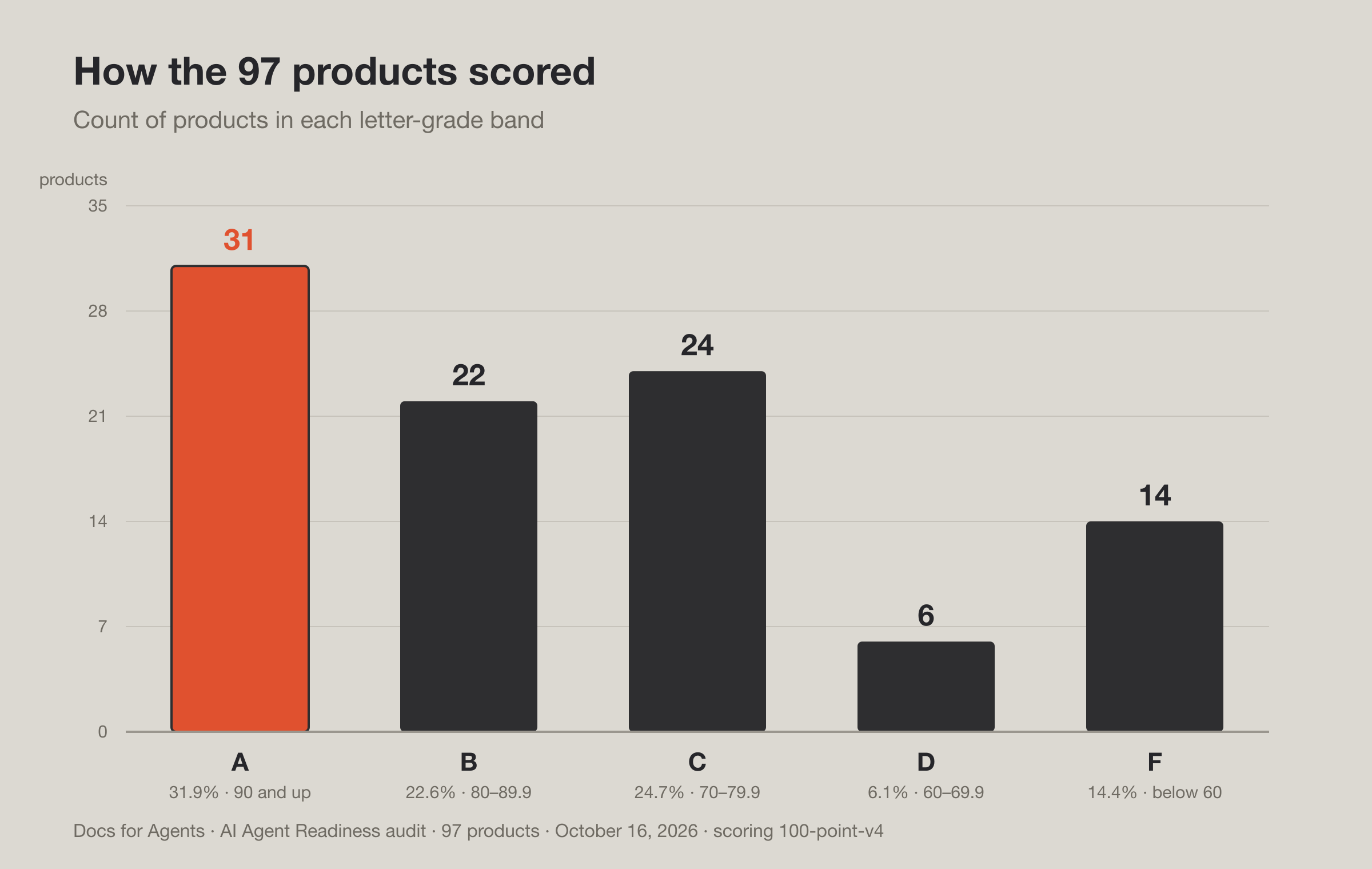
The 97 scores run from 24.5 to 99.0 out of 100. The mean is 79.6 and the median is 85.7, and a median that sits above the mean is the signature of a cluster of high scorers with a longer tail of low ones. 53 of the 97 products score 80 or higher, which lands at a B- or better on the letter scale that runs from A+ at 97 down to F below 60. 31 of them reach the A band at 90 and up, while 14 score below 60 and take an F. The chart below shows the full distribution.
Figure 1. The 97 products by letter-grade band. The A band is the largest group, with 31 products, and 14 products score an F.
The distance between the strongest and weakest products is wide. The top quarter of the set, 24 products, averages 94.3 points. The bottom quarter, another 24, averages 58.8, a spread of 35.5 points between two groups drawn from the same audit. Five products reach A+ at 97 or higher: Middesk and Postman both score 99.0, and Clerk follows at 98.0, all public on [the grades table](/grades/).
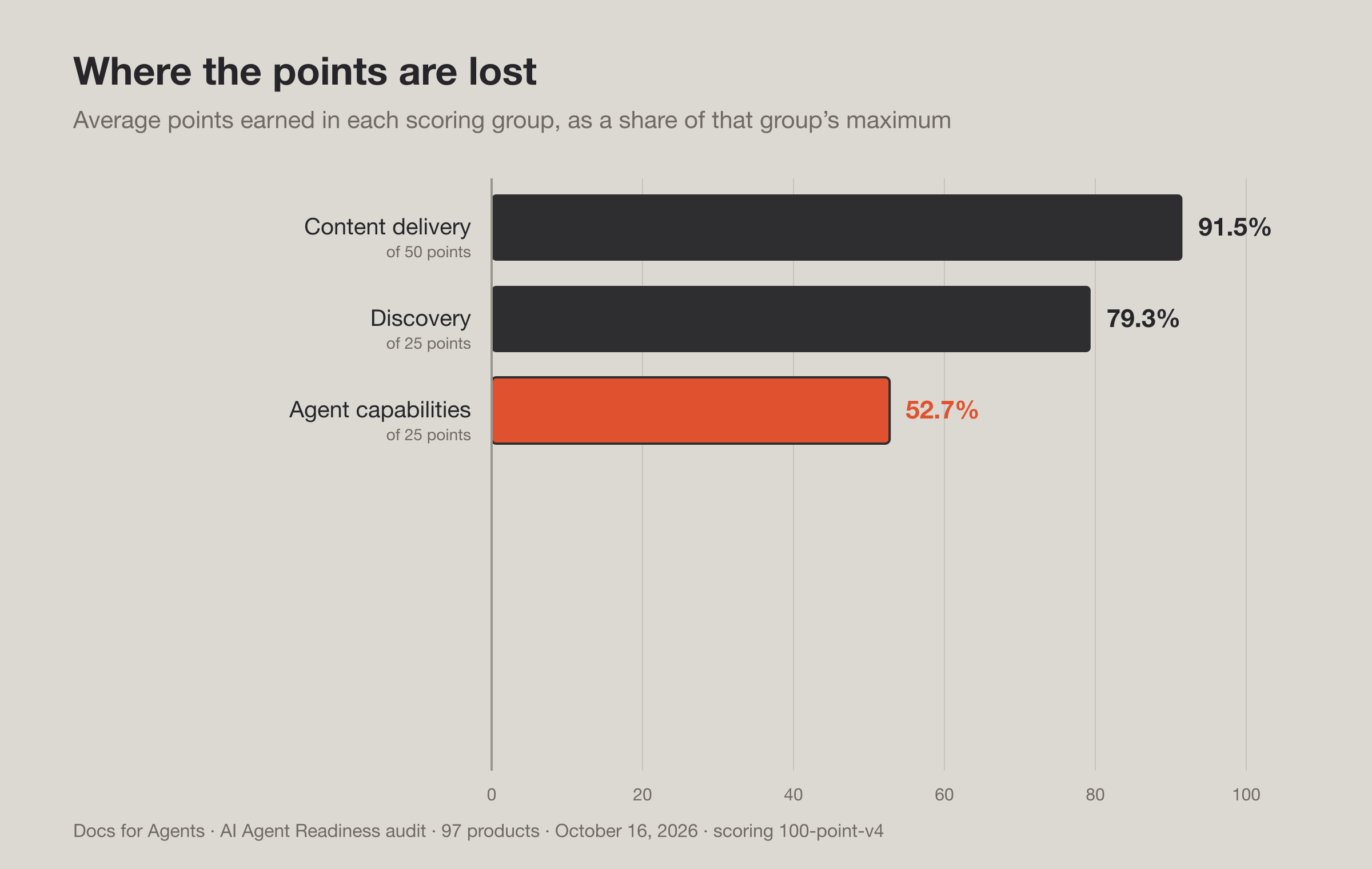
The three scoring groups divide those points unevenly. Content delivery averages 45.8 points of its maximum of 50, which is 91.5 percent of the group, and 71 of the 97 products take all 50. Discovery averages 19.9 of 25, or 79.3 percent. Agent capabilities averages 13.2 of 25, or 52.7 percent, and the extremes of that last group are the sharpest in the dataset: 1 of the 97 products takes every capability point, and 16 score zero. The chart below puts the three groups side by side.
Figure 2. Average points earned in each scoring group, as a share of the group maximum. Agent capabilities is the weakest group, at 52.7 percent.
## What agents can reach, and what they cannot
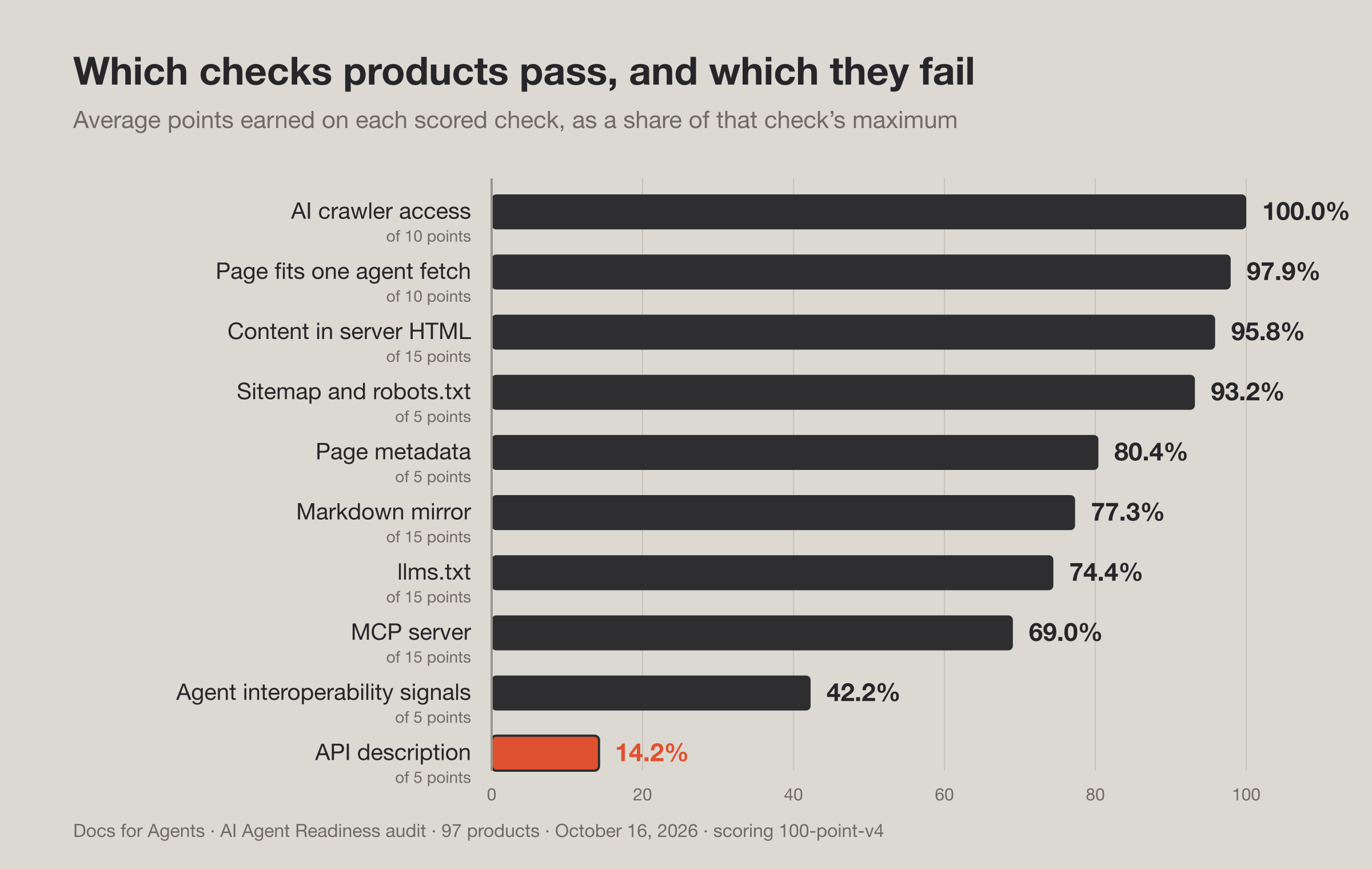
The passing checks describe the page itself. On the robots.txt check, the site-root file that tells automated crawlers which paths they may fetch, all 97 products earn full points, which means AI search and user-triggered fetch agents are allowed through. 94 products ship a documentation page that fits one agent fetch, so the agent needs no follow-up requests for the main text. 93 deliver the content in the server HTML, so the page reads without executing JavaScript in a browser. 85 keep both a valid sitemap and a valid robots.txt in place. Taken together, the page in front of the agent is almost always reachable and readable without a browser. The chart below shows how the 97 products sit on these individual checks.
Figure 3. Average points earned on each scored check, as a share of the check maximum. API description is lowest, at 14.2 percent.
The checks where points disappear concern the interfaces behind the page. The API description check is the weakest in the audit: products take 14.2 percent of its maximum, and 72 of 97 score zero. An OpenAPI document, the standard machine-readable description of an HTTP interface, appears on 9 products. A /.well-known/api-catalog, a catalog file at a fixed web address where a site declares the interfaces it exposes, appears on 21. In the remaining cases an agent that wants a structured description of the interface has only the prose of the page to work from.
Other points reward interoperability signals such as Content Signals, directives in robots.txt that state how AI systems may use fetched content, an agent skills index, and an MCP server card. Products take 42.2 percent of this check's maximum. 26 of 97 score zero on it, and only 3 take every available point.
The largest single check inside the agent capabilities group concerns the Model Context Protocol (MCP), an open standard that defines how an agent connects, in a session, to tools a product exposes through a server. Products take 69.0 percent of this check's maximum. 67 of the 97 expose an MCP server that the auditor could reach, and take the full 15 points; of those 67, 46 completed a live initialize handshake, the protocol's opening exchange, and 21 answered with a standard authentication challenge. The remaining 30 products score zero on MCP: 21 publish no server, and 9 declare one that could not be verified live.
## Discovery indexes and docs platforms
Discovery has a standard front door. A file named llms.txt is a plain-text index that a site publishes at its root, listing documentation links for a language model to read. 93 of the 97 products ship a valid one. Only 28 take the full points on this check, so an index exists in nearly every case, and an index that satisfies every point is much less common.
The supporting counts thin out in the same direction. 60 of 97 keep the file under 50,000 characters, small enough to read in one fetch, and 48 have sampled llms.txt links that return Markdown, so following those links produces usable text. 75 of 97 publish a Markdown version of the audited page, which gives an agent a plain-text path to the same content it read in HTML.
Above the scored maximum, the two extra-credit items follow the same uneven pattern: 61 of 97 ship llms-full.txt, a companion file that compiles a broader portion of the documentation into one download, and 16 embed a docs AI assistant in the documentation itself.
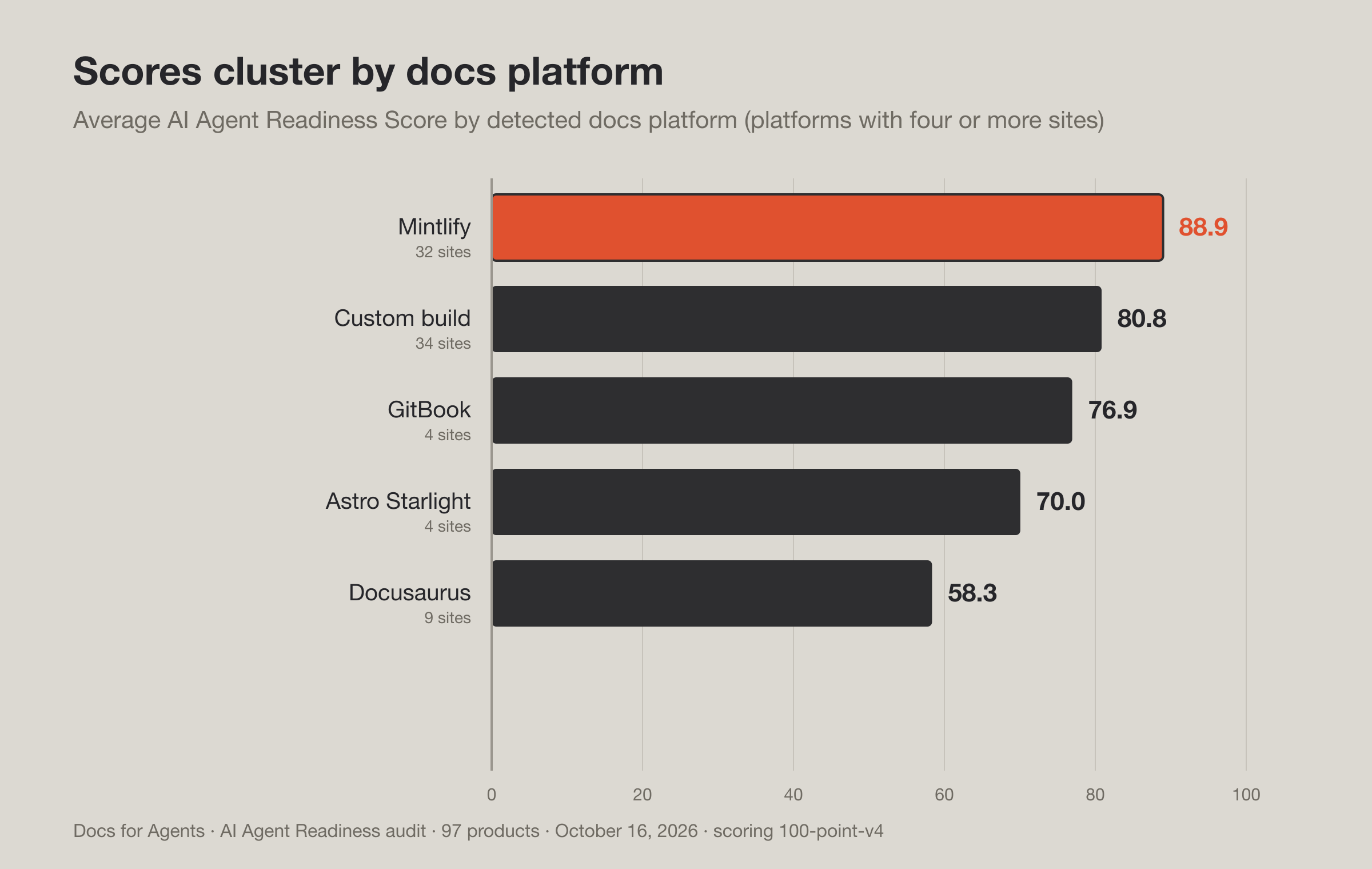
Alongside the score, the audit records each product's documentation platform as metadata, and that metadata is never scored. The averages still differ by platform: the 32 sites that run Mintlify average 88.9, the 34 custom builds average 80.8, and the 9 Docusaurus sites average 58.3. The chart below shows those averages.
Figure 4. Average AI Agent Readiness Score by detected docs platform, for platforms with four or more audited sites. The platform is recorded as metadata and is never scored.
These averages reflect the configuration each site actually delivers. A default installation and a deliberately configured installation produce different results on the same tool, so the figures describe an association between a platform and readiness, and they should not be read as feature comparisons between the tools.
## What the numbers do not measure
The audit reads one documentation page per product and the site-wide files around it, so it is a deep look at one page, not a crawl of everything a product ships. It measures delivery, which means it can confirm that a page arrived intact and is silent on whether the prose answers a developer's question correctly. Comprehension was the target of a retired prior method, which asked a panel of AI models to read documentation and respond to it. That reading test was retired on October 16, 2026, and it produced none of the scores in this article.
The 97 products are a set someone chose to audit, so the counts describe that set and are no industry survey. Every score reflects the documentation as it stood on the audit date, and pages change. A site that blocks or slows the auditor can also score lower than it would for a real agent, and each [per-product report](/reports/) labels any check that came back inconclusive.
None of the surfaces described here, including an MCP server, is required on every product. Documentation can serve an agent well through several combinations of surfaces, and the right surface depends on the workflow the agent is meant to run.
## Where the full results live
Every number in this article comes from the audit of October 16, 2026, scored on the 100-point-v4 version. The full grades table is at [/grades/](/grades/), and the per-product reports are at [/reports/](/reports/).
Canonical URL: https://docsforagents.com/blog/what-97-developer-docs-deliver-to-ai-agents/